

Employee attendance in workplaces directly impacts productivity, costs, and team morale. Frequent absences or late arrivals slow operations and increase expenses. This also puts extra pressure on other staff. On the contrary, good attendance keeps work smooth and shows responsibility.
To address attendance issues, companies often rely on clear policies, supportive management, and smart attendance systems. But beyond the basics, there are more innovative approaches that can make a real difference. Now, let’s explore ways to improve employee attendance at work that can help HR teams and business leaders build a more reliable and motivated workforce.
1. Implement Clear and Consistent Attendance Policies
Attendance management only works when rules are clear. Confusing rules make consequences unclear to employees. In many offices, employees are unclear about late arrival limits or leave rules.
For example, a Dhaka-based IT company found that some staff arrived 30 minutes late regularly. Later, they discovered that the attendance policy wasn’t clearly explained to the employees. Rules must be enforced consistently by management and announced wisely.
Consider the following factors to keep attendance rules clear and fair:
- Explain Terms: Say what counts as on time, late, excused, or unexcused.
- Set Limits: Give clear warnings and penalties, and follow them every time.
- Share Rules: Put rules in handbooks and talk about them in meetings.
- Be Fair: Treat all employees the same way.
- Allow Exceptions: Accept absences for real sickness or emergencies.
2. Use an Effective Employee Attendance Tracking System
Without a valid tracking system, attendance control is unorganized. Manual marking leads to misinterpretation and errors. Many companies use manual registers. This allows workers to sign for absent colleagues. An open and automated employee attendance tracking system ensures fair examination of each employee, enhancing credibility. In the long term, it also uncovers attendance patterns that are helpful for strategic workforce planning and decision-making.
To run a good attendance system:
- Use Automated Tracking Software: Replace manual recording methods with digital employee tracking systems to ensure accuracy.
- Integrate Biometric and Mobile Systems: Utilize features like Fingerprint or facial recognition to reduce proxy attendance.
- Be Open: Let employees see their own attendance easily using self-service portals.
- Link to Payroll: Connect attendance to salaries or bonuses to keep accountability.
PiHR is a comprehensive attendance management system to simplify attendance tracking and employee leave management in workplaces across Bangladesh. This software automates attendance tracking through biometric devices, mobile GPS check-ins, and integration with payroll. With PiHR, HR managers can monitor employee check-ins and check-outs, late arrivals, and leaves in real time.
3. Encourage Open Communication About Attendance Issues
Strict attendance policies have the effect of generating silence instead of honesty. Employees will not speak the truth where they are afraid of criticism or retaliation. For example, a sales executive took frequent unplanned leaves. Also, the employee never informed HR about his family problems. Fear of judgment or lack of flexibility to share personal problems often causes this kind of problem.
To encourage clear communication about attendance:
- Establish Open Discussion: Let employees speak about attendance without fear.
- Meet Privately: Talk one-on-one to solve attendance problems.
- Explain Rules: Make sure everyone knows the leave rules.
- Ask Early: Tell employees to inform before taking leave.
- Listen to Feedback: Use boxes or online forms for honest ideas.
4. Offer Flexible Work Options
Fixed scheduling has a way of pushing good employees into avoidable absences. Private responsibilities, long commutes, and unforeseen life circumstances don’t always fit the typical 9-to-5. For instance, One employee from Uttara often reached late at the office in Narayanganj. This is not due to laziness but travel delays. Flexibility in work shifts the focus from presence to outcomes. When employees are given space to better control life, attendance improves in itself.
To improve attendance and allow flexibility:
- Hybrid Work: Let employees work from home on some days.
- Flexible Hours: Allow staff to start early or late when needed.
- Job-Sharing: Two employees can share one position if full-time is hard.
- Shift Swaps: Let workers exchange shifts when necessary.
- Focus on Results: Measure work by quality and deadlines, not hours.
5. Reward and Recognize Good Attendance
Regular attenders do not often receive attention. Attention, however, is given to absent employees. Such discrepancy discourages motivation among reliable employees. For example, some employees maintained perfect attendance for months, but management never noticed. Thus, others will find no reason to come on time.
Appreciation of regular attendance encourages responsibility and engagement. This appreciation does not have to be financial in nature; it can be social or symbolic. Consider the following factors to improve employee attendance by appreciating them:
- Recognize Good Attendance: Reward employees who are regular and punctual.
- Give Small Rewards: Offer small incentives, gift cards, or extra time off.
- Appreciate Publicly: Highlight consistent employees in meetings or company newsletters.
- Show Progress: Use simple charts or boards to display attendance results.
6. Find and Fix the Root Causes of Low Attendance
Chronic absence rarely occurs in isolation. It may be due to exhaustion, individual stress, or inadequate managerial support. As leaders ignore these warning signs, discontent builds silently.
There’s been a case at a factory in Narayanganj that workers often missed shifts due to transportation issues and unsafe road conditions at night. A careful examination uncovers these underlying factors. With a fair and formal response, attendance reform can become a meaningful step toward organizational change.
To identify and repair attendance problems:
- Have Honest Talks: Speak privately with employees and listen before giving feedback.
- Watch Patterns: Track who is absent, when, and why to see trends.
- Check Workload: Make sure work is fair and not too much for anyone.
- Look at Manager Relations: Poor management can cause absences more than sickness.
- Give Real Support: Offer counseling, mentoring, or flexible work to show care.
7. Create an Attendance Improvement Plan
Sometimes, frequent absent issues cannot be addressed through verbal warnings. A formal attendance improvement plan brings measurable objectives and fair evaluation procedures. It simplifies managerial functions with organizational policy. Employees feel secure when policies appear logical and transparent. Thus, attendance management becomes a collaborative effort rather than a cause of conflict.
To make a good attendance plan:
- Start with Data: Look at past attendance of employees and reasons for absence.
- Set Clear Goals: Announce goals like reducing unplanned absences by 30% in the next three months.
- Make Personal Plans: through simple improvement plans.
- Offer Coaching: Provide guidance and support for employees with frequent absences by connecting them with understanding managers.
8. Offer Wellness Programs and Foster Employee Well-being
Fatigue and subtle stress are common absence causes. Employers neglecting well-being have lower employee engagement and rising absences. For example, a call center team saw frequent absences during exam periods due to burnout. Wellness promotion is a smart investment in workplaces. Employees who feel valued and supported tend to stay healthy, focused, and consistently present at work.
To encourage wellness and improve attendance:
- Balance Workload: Avoid giving too much work and watch stress levels.
- Give Health Support: Offer gyms, health check-ups, or online wellness classes.
- Care for Mental Health: Encourage open conversations about stress and train managers to recognize early signs of burnout.
- Value Healthy Habits: Praise and reward employees who keep a healthy balance.
9. Coach Managers on Attendance Management
Effective attendance enforcement involves fairness and understanding. Too many managers rely solely on consequences without causal behavior. For example, a manager scolded employees publicly for being 5 minutes late, while the other manager ignored frequent latecomers. This approach damages morale and destroys respect while creating confusion also.
Strong leadership requires balance and empathy. By recognizing early signs of disengagement and guiding improvement, leaders sustain attendance and preserve workplace harmony.
To train managers for improving attendance management:
- Provide Structured Training: Implement digital systems and train managers to track attendance, analyze data, and resolve disputes.
- Teach Empathy: Managers are to recognize signs of disengagement and address underlying issues.
- Standardize Decisions: Use open rules so that all managers handle absences in the same way.
10. Encourage a Positive and Engaged Work Culture
Healthy culture preserves presence and performance in equal balance. Workers give their heart to their work when they are valued. In a office, managers began praising small wins and asking employees for ideas. People started sharing challenges freely, and soon Monday absences dropped noticeably. Continuing recognition and respect build long-term trust.
To build a culture that supports good attendance:
- Show Work Value: Help employees see that their work matters.
- Promote Teamwork: Support group projects and shared goals.
- Ensure Safe Voices: Let everyone share ideas or concerns without fear.
- Offer Growth: Give training and chances to learn and grow.
- Check Engagement: Use feedback to make the workplace better.
How to Address Employee Attendance Issues?
Employee attendance is very important. When people miss work without notice, it slows down projects, makes coworkers do extra work, and lowers productivity. That’s why it’s essential to check the employee’s attendance record right away when a problem happens.
Inquire why it happened and listen carefully without interrupting. Let the employee face the consequences immediately if any rules are broken, such as a warning or written notice. Discuss what to do next, like making up work or reporting properly next time. Write down the conversation, reasons given, and agreed actions for HR records.
How Do You Handle Tardiness and Late Arrivals?
Being late or arriving after time disturbs work and sets a bad example for others. Solving this problem quickly keeps things fair and builds responsibility.
- Check the employee’s attendance record to see exact days and times they were late.
- Show them the specific late instances and explain the impact on work and team.
- Ask why they were late and note any reasons they give.
- Remind them of the company rule on punctuality.
- Record the discussion and any agreed follow-up in writing.
How to Reduce Absenteeism in the Workplace?
Absenteeism means employees miss work without a good reason. They may miss work sometimes or often. Reducing absenteeism includes the following steps:
- Keep accurate records of absent employees using a digital tracking system.
- Use wellness programs or flexible schedules to support employees.
- Reward employees who come to work regularly.
- If someone keeps missing work, follow a corrective action plan.
How to Write a Corrective Action Plan for Attendance Issues?
A corrective action plan is a way to help employees follow attendance rules. It shows what is expected and what will happen if rules are broken. The steps to create a corrective action plan are:
- State the Problem: Write the exact days and times the employee was late or absent.
- Show the Rules: Notify the employee about the attendance rules they must follow.
- Set Goals: Give clear and simple targets for coming on time and attending work.
- Explain Consequences: Tell the employee what happens if goals are not met.
- Ask for Feedback: Let the employee agree with the plan and share any problems.
- Check Progress: Monitor further attendance to see if it improves.
How to Create an Employee Attendance Improvement Plan?
An improvement plan helps employees come to work on time. It guides them to follow the rules. The steps are:
- Check Attendance History: Look at past attendance to find patterns or problems.
- Set Simple Goals: Give clear targets for being on time and attending work.
- Work with the Employee: Help the employee adjust their schedule or workload. Solve problems that make attendance hard.
- Provide Help: Give support like counseling, mentoring, reminders, or wellness programs.
- Watch Progress: Check regularly to see if attendance is improving. Give feedback.
- Write Everything Down: Record meetings, agreed actions, and progress to keep things clear.
- Change the Plan if Needed: If progress is slow, adjust goals or try new methods.
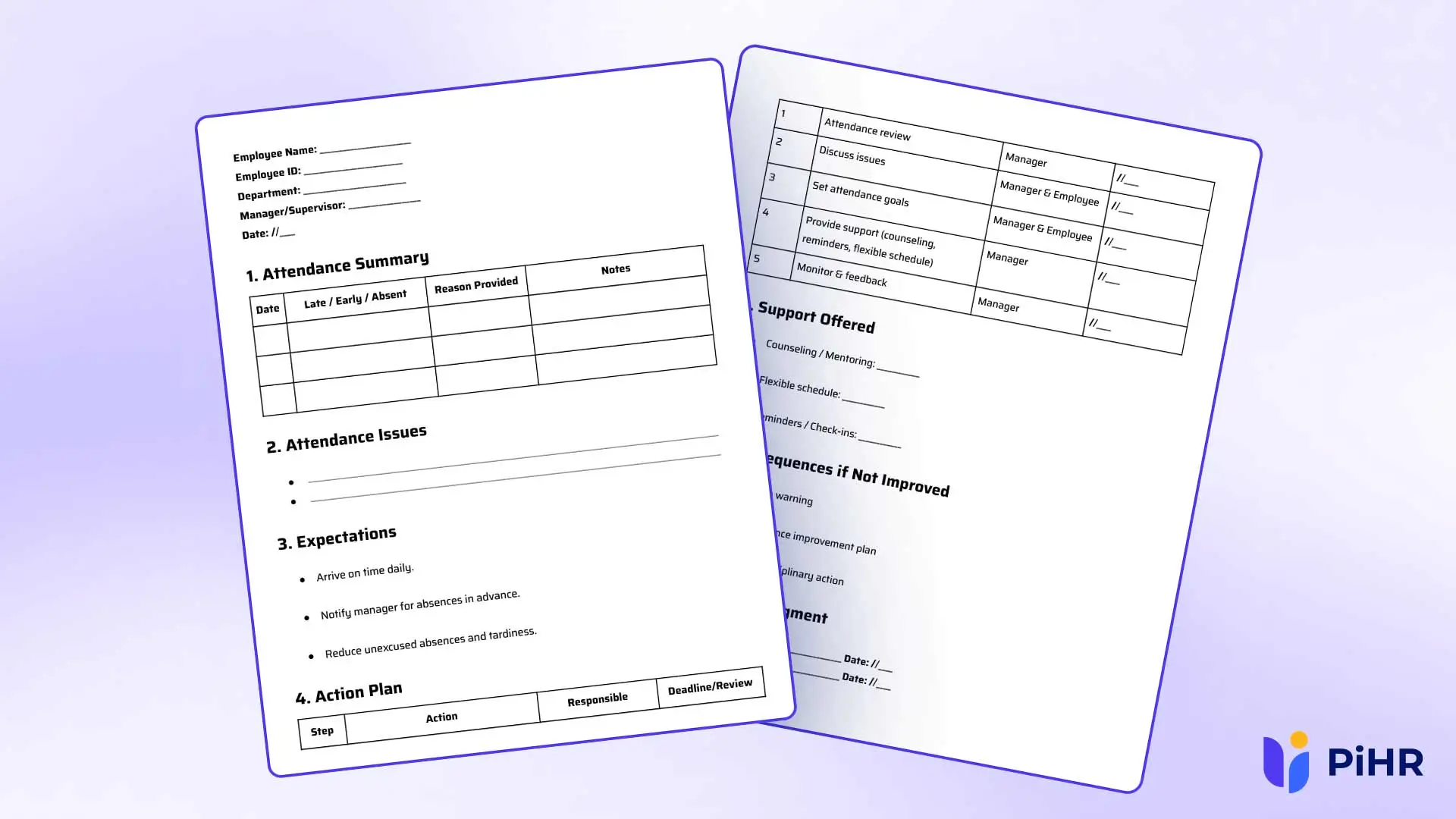
Sample Employee Attendance Improvement Plan
Here’s a simple template managers can use to track and improve employee attendance. It’s ready to download and fill in.
What Role Does Technology Play in Attendance Management?
Technology improves attendance tracking by increasing speed and accuracy. Today’s digital tools, like attendance management software, make tracking simpler and help organizations reduce wasted time and effort. The Advantages of attendance management software solutions are:
- Reduced manual errors: The system automatically records work hours accurately, including breaks, overtime, or missed punches.
- Cost-effective method: Attendance management solutions eliminate extra labor, helping companies avoid unnecessary overtime and use resources wisely.
- Improved security: Employee details, payroll information, and contracts are stored safely, with limited access to only authorized people.
- Less paperwork: No more piles of forms or lost files. Everything is digital, saving both time and office supplies.
- Simplified payroll: Employee work hours, overtime, and breaks are calculated automatically by following company rules and cutting down manual work.
- Fraud and time theft drop: Automated tracking prevents fake check-ins and ensures fair data for everyone.
- Automated report generation: Monthly attendance, overtime, or absence trends can be checked instantly without digging through files.
What is the Best Attendance Tracking and Improvement Software in Bangladesh?
PiHR is a leading attendance management software in Bangladesh with comprehensive features for employee tracking. It connects directly with payroll for easier payroll management. Most importantly, the software is customizable, easy to use and keeps employee data safe on a cloud-based storage. With automated report generation PiHR is a strong choice for improving attendance and managing staff efficiently.
Final Thoughts
Improving employee attendance requires a consistent and practical approach. Open communication, flexible work options, a supportive work environment and rewarding strategies keep employees more engaged at work. Software solutions like PiHR simplify attendance tracking and provide real-time insights. By combining clear policies with automation and insights, organizations can create a reliable attendance culture.